ΚΑΤΗΜΑNDU
UNIVERSITY
Kathmandu University emerging after Covid:
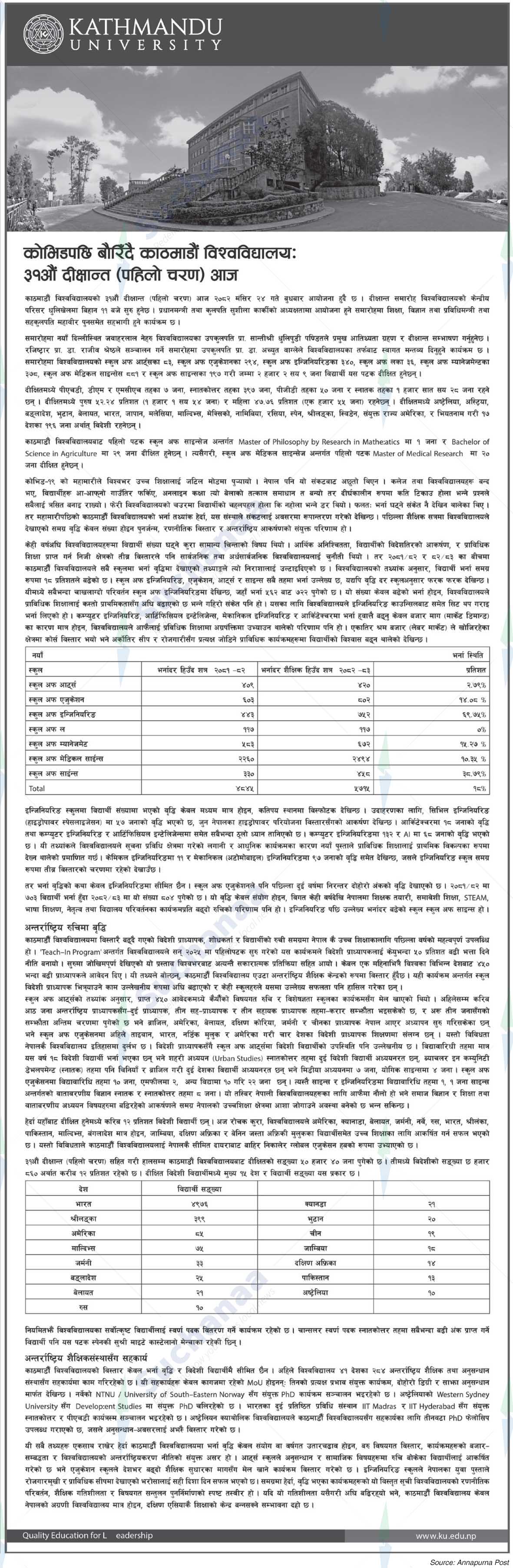
31st convocation (first phase) today
Kathmandu University's 31st convocation (first phase) is being held today, Wednesday, November 24, 2082. The convocation ceremony will begin at 11 am at the university's central campus, Dhulikhel. The ceremony, which will be chaired by Prime Minister and Chancellor Sushila Karki, will also be attended by Minister for Education, Science and Technology and Pro-Chancellor Mahabir Pun.
At the ceremony, Vice Chancellor of Jawaharlal Nehru University, New Delhi, Prof. Santishree Dhulipudi Pandit will be the chief guest and will deliver the convocation address. The ceremony, which will be conducted by Registrar Prof. Dr. Rajiv Shrestha, will be graced by Vice Chancellor Prof. Dr. Achyut Wagle, who will deliver the welcome address on behalf of the university. A total of 2,209 students, including 83 from the University's School of Arts, 294 from the School of Education, 340 from the School of Engineering, 36 from the School of Law, 378 from the School of Management, 881 from the School of Medical Sciences and 197 from the School of Science, will be inducted this time.
Among the graduates, there will be 7 PhD, DM and MCH levels, 397 postgraduates, 50 PGD and 1,728 undergraduates. Among the graduates, 52.24 percent (1,154) will be male and 47.76 percent (1,055) will be female. Among the graduates, 196 foreigners will be from 17 countries including Australia, Austria, Bangladesh, Bhutan, Britain, India, Japan, Malaysia, Maldives, Mexico, Namibia, Russia, Spain, Sri Lanka, Sweden, the United States and Vietnam.
For the first time, Kathmandu University will induct 1 person in the Master of Philosophy by Research in Mathematics and 29 in the Bachelor of Science in Agriculture under the School of Sciences. Similarly, for the first time, 20 people will induct 20 people in the Master of Medical Research under the School of Medical Sciences.
The COVID-19 pandemic has thrown higher education across the world into a complex situation. Nepal was no exception to this crisis. Colleges and universities were closed, students returned to their villages, online classes were an immediate solution at the time, but the question of how sustainable they would be in the long term kept everyone worried. There was fear of whether students would be able to move around the university campus again. As a result, there were signs of a decline in enrollment. But looking at the enrollment figures of Kathmandu University after the pandemic, it seems that this institution has turned the crisis into an opportunity. The overall growth shown by the university in recent academic sessions is not just a matter of numbers but a combined result of rebirth, strategic expansion, and international attraction.
A few years ago, the decline in student numbers in universities was a common concern. Economic uncertainty, the attraction of students abroad, and the rapid expansion of the private sector to pursue technical education also posed challenges to public and semi-public universities. But the figures shown by Kathmandu University on the increase in enrollment in all schools between 2081/82 and 82/83 have reversed that disappointment. According to the university’s figures, student enrollment has increased by 18 percent overall. Enrollment is significant at all levels in the Schools of Engineering, Education, Arts, and Science, although the rate of growth varies from school to school. The most interesting change is seen in the School of Engineering, where enrollment has increased from 562 to 722. This number is not just an increase in enrollment, but also a profound indication of the priority the university has given to technical education. For this, the university has also obtained additional seats from the Engineering Council. The surge in enrollment in computer engineering, artificial intelligence, mechanical engineering, and architecture is not only due to market demand, but also a result of the university positioning itself at the forefront of technical education. On the one hand, the expansion of courses in areas that the labor market is looking for, while on the other hand, student confidence in technical programs that are directly linked to skills and employment seems to be increasing.
New
school
School of Arts
School of Education
School of Engineering
School of Law
School of Management
School of Medical Sciences
Enrollment status
Enrollment rate winter semester 2081-82
Enrollment rate academic winter semester 2082-83
percent
409
420
2.79%
603
802
14.08%
443
752
69.75%
117
117
0%
583
672
15.27 %
2260
2494
10.35 %
330
458
38.79%
4845
5715
18%
School of Science
Total
The growth in student numbers in engineering schools is not only moderate, but also explosive in some places. For example, there has been an increase of 57 in civil engineering (hydropower specialization), which is evident from the expansion of hydropower projects in Nepal. Architecture has seen an increase of 18, and computer engineering and artificial intelligence have also attracted the most attention. Computer engineering has seen an increase of 132 and AI has seen an increase of 68. These figures prove that the new generation is starting to see technical education as a primary option due to the university’s investment in the information technology sector and modern programs. There is also an increase of 11 in chemical engineering and 97 in mechanical (automobile) engineering, which shows that the engineering school as a whole is in a phase of rapid expansion.
But the story of enrollment growth is not limited to engineering. The School of Education has also shown consistent double-digit growth over the past two years. From 703 students enrolled in 2081/82, the number has increased to 804 in 2082/83. This growth is not just a coincidence, but also a result of the growing interest in teacher preparation, inclusive education, STEAM, language teaching, leadership and school transformation programs in Nepal over the past few years. The School of Science is the school with the most significant enrollment growth after Engineering. Growing international interest
The growing interest of foreign professors, researchers and students in Kathmandu University is a significant achievement for higher education in Nepal in recent years. The university, which first launched this program in 2025 under the 'Teach-In Program', made a policy of giving foreign professors 50 percent more allowance than KU. This proposal, which initially seemed risky, received an overwhelmingly positive response from around the world. Within just a month, more than 450 professors from different countries around the world applied. These facts speak for themselves that Kathmandu University is expanding as an international educational center. Under this program, schools have significantly advanced the work of bringing in foreign professors and some schools have also achieved significant success in this.
According to the School of Arts, out of the 450 applicants received, many had subject interests and expertise that matched the school's programs. So far, contracts have been signed with about eight international professors at the levels of two professors, three associate professors and three assistant professors, and agreements with three others are in the final stages. Professors from Brazil, the US, the UK, South Korea, Germany and China have come to Nepal and started teaching, while the School of Education currently has foreign professors from four countries - Taiwan, India, the Nordic countries and the US - involved in teaching. Such diversity is rare in the history of Nepal's universities. Along with foreign professors, the presence of foreign students in the School of Arts is also notable. This year, 18 foreign students have been admitted to the doctoral level alone, while two foreign students are studying at the master's level in Urban Studies, and two students from two countries - Chinese and Brazilian - are studying at the Bachelor of Community Development (Bachelor's) level, seven in Media Studies, and four in Yogic Science. The School of Education has 22 students, including 10 at the PhD level, 2 at the MPhil level, and 10 in other disciplines. Similarly, there are 1 at the PhD level in Science and Engineering, 1 at the Bachelor of Science in Environmental Science, and 8 at the Master of Science level. While this picture is new for Nepali universities, the growing attraction towards social sciences, education, and environmental studies has created a hopeful situation in the higher education sector of Nepal as a whole.
It is seen that about 12 percent of the graduates from here are foreign students. Interestingly, the university has been successful in attracting students not only from the US, Canada, UK, Germany, Norway, Russia, India, Sri Lanka, Pakistan, Maldives, Bangladesh, but also from African countries like Zambia, South Africa and Benin for higher education. Such diversity has taken Kathmandu University beyond the limited scope of Nepal and established it as a global education hub.
Including the 31st convocation (first phase), the number of graduates from Kathmandu University has reached 50,040 so far. Of these, the number of foreigners is 6,860, or about 12 percent. The top 15 countries and the number of students among the foreign students enrolled are as follows.
the country
Number of students
India
4976
Canada
21
Sri Lanka
399
Bhutan
20
America
85
China
19
Maldives
75
Zambia
18
Germany
33
South Africa
14
Bangladesh
25
Pakistan
13
Britain
21
Australia
10
Russia
10
As usual, there is a program to distribute gold medals to the best students of the university. The student who scored the highest marks at the Chancellor's Gold Medal postgraduate level this time is Ms. Maite Castellano Menchaca from Spain.
Collaboration with international educational institutions
Kathmandu University’s expansion is not limited to increased enrollment and foreign students. The university currently collaborates with 284 international academic and research institutions in 41 countries. These collaborations are not just MOUs on paper: their direct impact is seen through joint programs, double degrees, and joint research. A joint PhD program is being conducted with NTNU / University of South-Eastern Norway in Norway. A joint PhD in Development Studies is being conducted with Western Sydney University in Australia. Joint master’s and PhD programs are being conducted with two prestigious Indian institutes of technology, IIT Madras and IIT Hyderabad. The Australian Catholic University has provided three PhD fellowships for collaboration with Kathmandu University, which has significantly expanded research opportunities.
Taken together, the growth in enrollment at Kathmandu University is not a coincidence or a year-on-year fluctuation, but rather a combined effect of thematic expansion, market-relevance of programs, and the university’s internationalization policy. The Arts School has attracted students interested in research and social issues, while the Education School has expanded its programs to meet the growing demands of educational reform across the country. The Engineering School has succeeded in channeling the confidence shown by the young generation of Nepal in job-oriented and technical skills. Taken together, this extensive list of programs that have increased is a clear picture of the university’s strategic transformation, academic dynamism, and the rebuilding of subject balance. If this momentum continues, Kathmandu University has the potential to become not only a leading university in Nepal, but also a center of education in South Asia.
Quality Education for Leadership
www.ku.edu.np
Source: Annapurna Post

© 2026 Suchanaa. All Rights Reserved.